How Printed Photo Gifts Are Made: Sublimation, UV Printing and Embroidery
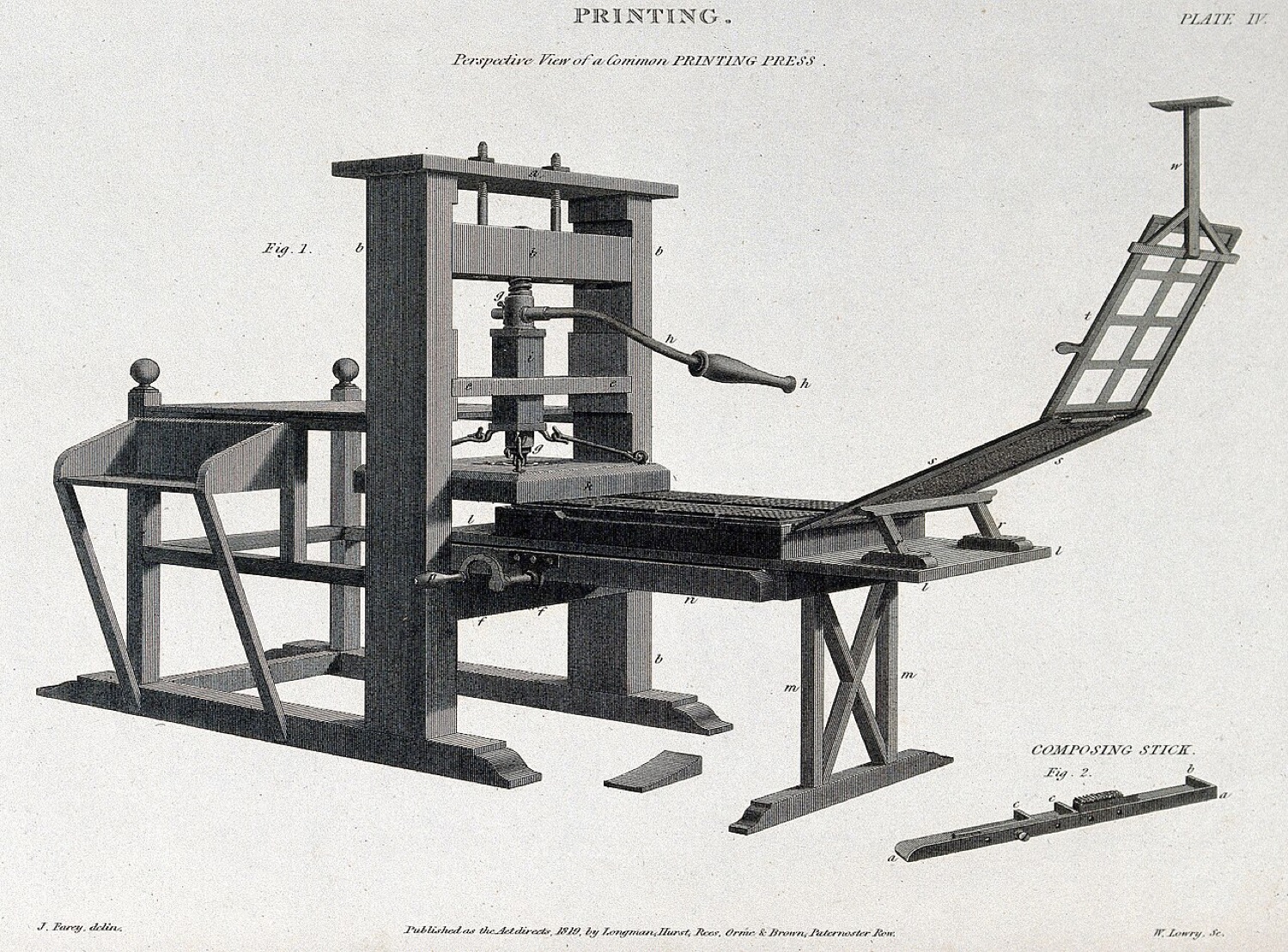
An engraving of a traditional hand printing press. Photo: John Farey, Public domain, via Wikimedia Commons.
- Department: Photo Gifts
- Published: 22 April 2026
- Reading time: 3 minutes
How printed and photo gifts are made: dye sublimation on mugs and slate, UV printing, embroidery, choosing photos at the right resolution, and personalised playing cards.
A photo mug, a printed slate, a cushion with a family picture: printed personalised gifts can carry any image you like, in full colour. How they are made decides how sharp they look and how long they last, so it is worth a few minutes to understand the methods.
Dye sublimation: mugs, slate and photo panels
Most photo mugs, printed slates, coasters, jigsaws and photo panels are made by dye sublimation. The design is printed in mirror image onto transfer paper with special inks; the paper is then pressed against the item under heat, and the ink turns into a gas that bonds with a polymer coating on the surface. The result is a smooth, durable image that is part of the coating rather than sitting on top of it.
Two limits follow from the process. First, sublimation only works on items with that special coating, or on polyester fabric, which is why printed slate has a white or pale panel. Second, there is no white ink: white areas of your photo simply show the colour of the surface underneath.
UV printing: rigid objects and wood
UV flatbed printers spray ink directly onto rigid objects (wood, acrylic, phone cases, glass) and cure it instantly with ultraviolet light. They can print white, so full-colour images work on dark or natural materials, and they can print raised textures. UV-printed images are tough, but on items that get heavy use, such as chopping boards, the surface can wear with time.
Textiles: embroidery, transfers and direct-to-garment
- Embroidery stitches a name or design into fabric. It is the most durable option for towels, bags, aprons and baby blankets.
- Direct-to-garment printing works like an inkjet for cotton T-shirts and suits photos.
- Heat transfers and vinyl suit bold text and simple shapes.
Choosing a photo that will print well
- Resolution: aim for about 300 pixels per inch at the final print size. A 10 x 15 cm print needs roughly 1,200 x 1,800 pixels.
- Use the original file: photos forwarded through messaging apps are often compressed. Ask the person who took it for the original.
- Mind the crop: mugs wrap around, so faces near the edge may end up by the handle.
- Contrast: dark, moody photos can look muddy on mugs and slate. Bright, evenly lit pictures work best.
- Permission: only print photos you took or have permission to use. Professional wedding photographers usually license prints for personal use, but check.
Children's drawings make wonderful prints. Scan them flat (rather than photographing them at an angle), increase the contrast a little and send them as a high-quality file.
Printed playing cards: Britain's oldest personalised print
Long before photo mugs, one printed object was being personalised in Britain: the playing card. London's card makers were important enough to receive a royal charter as the Worshipful Company of Makers of Playing Cards in 1628, and for centuries the state taxed every pack. That is why the ace of spades in British packs is so ornate: for long periods it carried the official duty mark, and the duty on playing cards was only abolished in 1960. Card companies printed bespoke packs for clubs, hotels, ocean liners and casinos, with the venue's name or crest on the backs.
Today anyone can order a deck with their own photographs on the faces or a wedding date on the back. Look for plastic or plastic-coated cards if they will be used for real games; paper cards bend and mark quickly when shuffled every week. A personalised deck is a lovely extra in a poker gift set (see our guide to gifts for poker players) or as table favours at a casino-night party, where each guest takes home the deck from their table.
Looking after printed gifts
Many sublimated mugs are dishwasher-resistant, but hand-washing keeps colours bright for longer, and very few printed mugs should go in the microwave if they have any metallic finish. Printed slate and photo panels should be kept out of strong direct sunlight to prevent fading. Embroidered items can be washed normally, inside out.
For engraving, the other big personalisation method, see how engraving works; for photo gifts as keepsakes, see keepsake boxes and photo gifts.
Related Guides
Premium Bonds as a Gift
Luck & Play

Personalised Home Accessories
Home Accessories
Personalised Sweet Jars, Chocolate Bars and Mints
Chocolate & Sweets
Thumbnail photos via Wikimedia Commons: Money box shaped like ERNIE the Computer (Science Museum, London) (Geni, CC BY-SA 4.0); Christmas Tree and Presents (Alhill42, CC BY-SA 4.0); Charcuterie board - Massachusetts (Daderot, CC0); Sweet jars in shop window - geograph.org.uk - 519847 (Philip Halling, CC BY-SA 2.0).